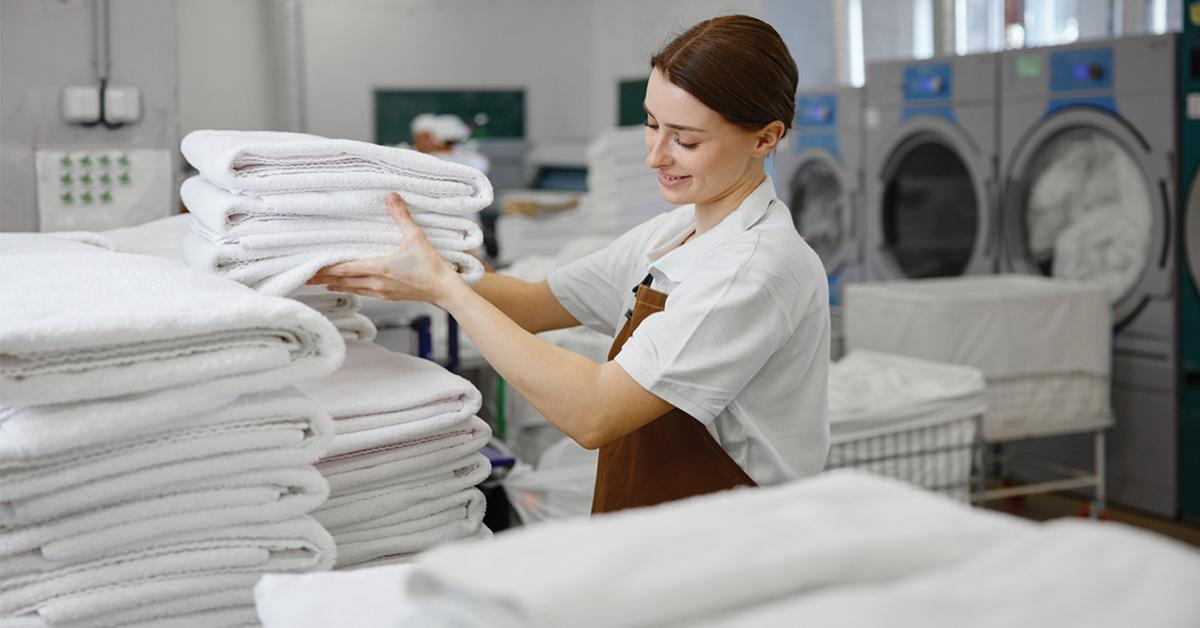
CHICAGO — Folding is a critical part of the finishing process for industrial and institutional laundries.
Clean, even folds offer customers professional-looking textiles, but achieving these folds consistently and efficiently can be challenging for an operator.
Folding technology has advanced on many fronts in recent years, and American Laundry News conferred with several providers of folding equipment to learn about those advances, how laundries can make solid folding-equipment selections, and what enhancements are to come.
FUTURE ENHANCEMENTS
While there are many questions and considerations when it comes to folding equipment, one thing is certain. The technology will continue to advance.
“We see continued movement toward intelligent automation,” shares Ed Kirejczyk, president of Sea-lion America. “Greater use of sensors and machine intelligence should allow equipment to recognize products and automatically adjust for different textile characteristics.
“Connectivity will also become increasingly important. Production data on throughput, downtime, faults and equipment utilization can help operators optimize their processes.
“We also expect more automation around the folder, including feeding, stacking, conveying, and product handling. Often the greatest labor savings come from eliminating the manual handling before and after the actual folding process.”
Tom Kindy, executive sales director for Chicago Dryer Company, states that further folding automation will be inevitable.
“Ensuring consistent quality, production, and delivery are valued and will benefit the laundry, the customer, and the end user,” he says. “What will be employed in the future may include clean sorting systems that remove mis-sorts and separate items for proper processing so that automated systems can efficiently finish the linens.”
“The future of folding technology is centered on practical automation: helping laundries improve consistency, reduce repetitive labor and make better use of their teams without adding unnecessary complexity,” says Joe Chenot, interim vice president of customer development for Foltex USA.
He adds that AI and vision technology will play a larger role in recognizing items, selecting the appropriate fold program, identifying mis-folds or quality issues, and providing better production data. Over time, these tools can help a laundry understand its throughput, identify recurring exceptions, and make faster decisions about staffing, workflow and maintenance.
Chenot adds that robotics will also become increasingly relevant, particularly in the material-handling steps around folding. This may include feeding, sorting, transferring, stacking and moving finished goods. These are often some of the most repetitive and difficult roles to staff. Robotics can help reduce those labor pinch points and create a more consistent flow of linen through the finishing area.
“For laundries, this does not mean people disappear from the process,” he stresses. “It means employees can spend less time on repetitive manual tasks and more time overseeing quality, managing exceptions, and supporting customer service. The strongest solutions will be the ones that combine automation with simple operation, dependable equipment, and a clear return on investment.”
Jim Slatcher, Western regional sales manager for LAVATEC, says that several manufacturers have been working on, and continue to develop, fully automated towel-folding equipment.
“While several companies have made significant progress in this area, major hurdles still need to be overcome before these systems become a practical solution for most laundry facilities,” he acknowledges.
“One of the primary challenges is the amount of floor space required. These fully automated systems typically require significantly more square footage than a conventional towel folder or the multi-sort towel folders currently available.”
Another consideration is production capacity, he says.
“Based on the latest information I have received from various manufacturers currently developing these machines, production rates are generally in the range of 600-700 pieces per hour,” shares Slatcher. “By comparison, a typical manually fed towel-folding machine can average approximately 800-1,000 pieces per hour. This represents a significant reduction in hourly production.
“However, the manufacturers developing these systems point out that automation provides other advantages. An automated system does not require breaks, lunch periods, or the same level of operator involvement as a manually fed machine. In theory, these systems can operate continuously 24 hours a day, which can help offset the lower hourly production rate when viewed over an entire operating shift or day.”
The final hurdle is cost, he points out. Even though system pricing has begun to stabilize, fully automated towel-folding equipment remains significantly more expensive than its manual-feed counterparts. As the technology continues to develop, manufacturers are working to improve production rates, reduce the required footprint, and bring the overall investment closer to what customers are accustomed to paying for conventional towel-folding equipment.
“Overall, fully automated towel folding is a technology that continues to evolve and shows considerable potential,” says Slatcher. “But based on the current production rates, space requirements and investment levels, there are several factors that need to be carefully evaluated before determining whether it makes sense for a particular facility.”
As synthetic fibers and thread counts continue to evolve, folder manufacturers will need to adapt machine capabilities accordingly, says Joseph Amaral, partner and executive vice president of business development for Lindsey Enterprises.
“We also anticipate a major push toward increased automation and tracking, specifically integrating barcode and RFID (radio-frequency identification) technologies directly behind the folders,” he says. “Vision systems will continue to advance, with manufacturers working to maximize their capabilities to ensure flawless quality.
“Finally, remote diagnostics will expand significantly. The industry will increasingly rely on remote dial-in capabilities and specialized apps that allow technicians to look inside a machine to diagnose mechanical issues, adjust formulas, or implement software changes from anywhere in the world.”
Brennan Pollnow, national sales manager for Girbau Industrial, expects continued advancements in automatic article recognition, more sophisticated machine controls and the ability to automatically adapt folding parameters with minimal operator intervention.
“In addition, greater integration between feeding, ironing, folding, stacking and production monitoring systems will continue to improve workflow visibility and operational efficiency,” he says. “Ultimately, the industry’s goal is to create finishing systems that intelligently respond to changing product demands while maintaining consistent quality, throughput and labor efficiency.”
“We’re focused on expanding the range of items that can be processed with robotics while making automation easier to support and maintain,” shares Casey Lott, marketing director for Kannegiesser North America. “As laundries adopt more technologies like the RFT and FA X-M, giving maintenance teams the tools and knowledge to manage these systems will be just as important as the automation itself.”
FINAL THOUGHTS
The most important takeaway from all the advancements in folding equipment, according to Amaral, is to not fear new technology.
“Operators are occasionally hesitant to upgrade because they worry their engineering staff won’t be able to maintain advanced systems, but these technologies are highly accessible,” he shares. “It is vital to stay informed. Operators should tour other plants, seek input from industry colleagues, and consult with manufacturers. The education process is a powerful tool to better your business, but only if you are willing to explore what is available.”
There is no one-size-fits-all approach to folding automation, Pollnow cautions.
“Today’s market offers solutions for virtually every production environment, from compact systems that combine multiple finishing functions to high-volume industrial folders designed for large-scale flatwork processing, as well as highly specialized towel-folding equipment,” he points out.
“The key is selecting technology that aligns with the specific articles being processed, production volumes, labor availability and facility constraints. Operators should also view folding as part of the entire finishing workflow rather than as a stand-alone process. When properly integrated, folding automation can improve productivity, consistency, labor utilization and the overall quality of the finished product.
“Working with an equipment partner that offers a broad range of finishing solutions can help ensure the right technology is selected for both current and future operational needs.”
Chenot agrees: “The most advanced solution is not always the right solution for a particular laundry. The real value comes from finding an equipment partner that understands the customer’s operation, listens to their challenges, and recommends a solution that fits their people, item mix, production goals, and facility.”
“Operators should not select equipment based solely on advertised production speed,” says Kirejczyk. “Real-world performance depends on product mix, feeding consistency, moisture content, operator interaction, and integration with the overall finishing system.”
He adds that the best folder is not necessarily the fastest one. It is the system that provides the right combination of throughput, flexibility, reliability, labor reduction and product quality for the individual laundry.
“The future of folding is less about a stand-alone machine and more about an integrated, automated finishing system,” shares Kirejczyk. “For today’s laundry operator, that approach is increasingly important for controlling labor costs and creating a scalable operation.”
Folding technology is just one piece of the puzzle, agrees Lott: “The biggest gains come when automation, data, and service work together to help laundries spot bottlenecks, improve performance, and make smarter decisions.”
“Laundry never sleeps,” says Kindy. “It is an often overlooked but essential service for industrial and institutional operations. Imagine a hospital that cannot provide clean linen to patients. Restaurants that do not have clean napkins or bar towels. Auto shops that do not have shop towels to wipe away grease. It is impossible to imagine because it does not work.
“Laundries provide a critical service, and manufacturers will continue to look for technology that will benefit the laundries, the customers that utilize them, and the general public that ultimately uses the finished product.”
Click HERE to read part 1 for recent advancements from industrial laundry folding equipment providers.
Read part 2 about more folding equipment performance upgrades by clicking HERE.
Click HERE for part 3 with advice on analyzing a laundry operation for folding equipment needs.
Have a question or comment? E-mail our editor Matt Poe at [email protected].